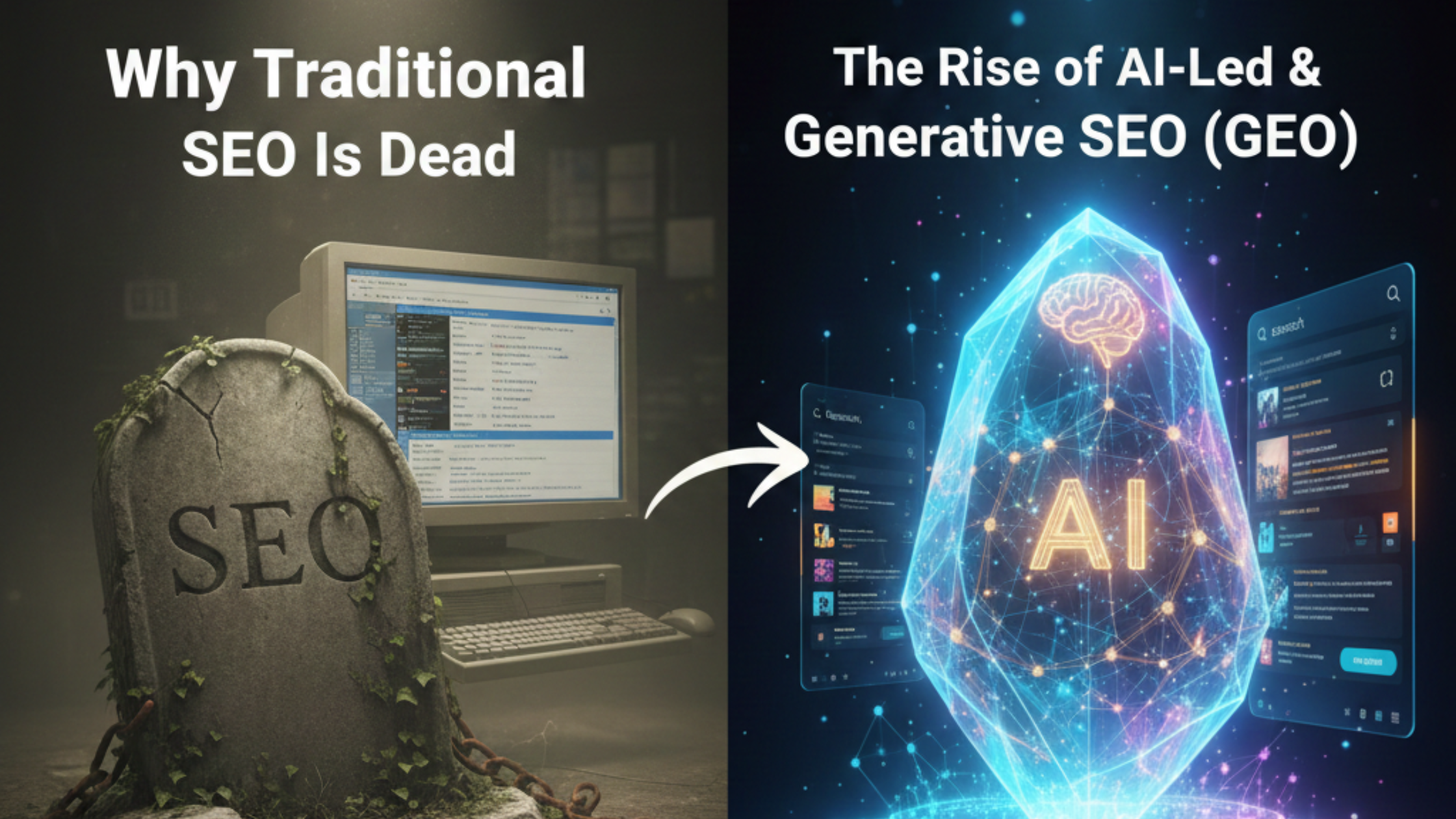
Many people still think SEO is only about keywords, backlinks, and writing blogs to “rank on Google.” That approach worked years ago. But search has changed a lot in 2024–2026 because AI systems now understand meaning, context, and user intent much better.
Today, shallow SEO is what’s dying. Not SEO itself. If a page is written just to match keywords, it may still get impressions, but it often fails to earn trust, clicks, and conversions. Search engines now reward content that answers real questions clearly, is easy to verify, and shows real experience.
This is where GEO (Generative Engine Optimization) comes in. GEO is about writing and structuring content in a way that both humans and AI tools can understand fast, trust more, and use as a reliable answer.
In this blog, we’ll break down:
- Why old SEO methods are failing
- What GEO really means
- How to build an AI-led SEO strategy that can scale
Is Traditional SEO Really Dead?
Traditional SEO is not fully dead. But old-style SEO that only focuses on keywords is not enough anymore.
Traditional SEO used to work like this:
- Pick a keyword
- Write 1,000 words
- Add the keyword many times
- Build a few links
- Expect rankings
This still works sometimes, but it is not a reliable way to win today.
Why?
Because search engines now try to give the best answer, not the page with the most keyword matches. They check:
- Does the page solve the user’s question?
- Is it written clearly?
- Does it look trustworthy?
- Does it match what people actually want?
If your content is vague, copied, or written just to “fill the page,” it gets ignored.
What SEO means now
- Search intent (what the user really wants)
- Topic depth (does the page cover the full idea?)
- Clarity (can someone understand it fast?)
- Proof (does it show real knowledge and examples?)
So no, SEO is not dead. Only shallow SEO is dying.
Why Keyword-Only SEO No Longer Works
Keyword-only SEO no longer works because search engines now understand meaning and intent, not just exact words.
Earlier, SEO was simple. If someone searched for “best SEO course,” pages that repeated this phrase many times had a higher chance to rank. Today, this logic is outdated.
Search engines now ask better questions:
- Does this page fully answer the query?
- Is the content helpful or just filled with words?
- Does it match what users usually expect for this search?
If the answer is no, rankings drop — even if keywords are present.
How search engines think today
- Context: what the full sentence means
- Intent: why the user searched
- Relevance: how closely the content matches the real need
For example, when someone searches for:
“AI SEO strategy for 2025”
They are not looking for:
- A definition of SEO
- A list of random tools
They want:
- How SEO is changing
- How AI fits into it
- What skills or steps matter now
A page that only repeats the keyword without answering these points will fail.
Keyword use vs keyword obsession
Keywords are still useful. But their role has changed. Today, keywords help search engines understand the topic, not decide rankings alone.
What matters more is:
- Topic coverage
- Clear explanations
- Related ideas explained in simple language
- Logical structure
This is why two pages targeting the same keyword can perform very differently. The better page is usually the one that explains the topic clearly and completely.
Why this matters for jobs and real work
In real companies, SEO professionals are not hired to “add keywords.” They are hired to:
- Understand user problems
- Map content to intent
- Improve traffic quality
- Support business goals
Keyword-only SEO does not teach these skills. That’s why many trained students struggle in real roles.
Key takeaway: Keywords help, but thinking matters more. SEO today is about understanding people, not just search terms.
How AI Has Changed the Way Search Engines Work
AI has changed search engines from keyword matchers into problem-solving systems.
Earlier, search engines mainly looked at:
- Keywords on a page
- Links pointing to that page
Now, AI systems help search engines understand:
- What the user is really asking
- Which content explains the topic clearly
- Which sources look reliable and experienced
This is a big shift.
From matching words to understanding meaning
Modern search engines use AI models that can read and understand text almost like humans do. They don’t just scan for the same words. They try to understand:
- The topic of the page
- How ideas connect
- Whether the content answers the question fully
Why AI Overviews exist
AI Overviews exist because users want fast, clear answers.
People now expect:
- Short summaries
- Clear explanations
- Trusted information
To create these summaries, AI systems look for content that:
- Answers questions directly
- Is easy to understand
- Is well structured
- Comes from a focused and credible source
What AI looks for in content
- Starts with clear answers
- Uses simple language
- Explains ideas step by step
- Avoids confusion and fluff
Content written only for rankings often fails here. Content written to help the reader performs better.
Why this change rewards real expertise
AI makes it harder to fake knowledge. Shallow content, copied blogs, and generic advice are easy to detect.
Pages that show:
- Real understanding
- Clear thinking
- Practical experience
Stand a much better chance of being trusted and reused by AI systems.
Key takeaway: AI has made search smarter. Content now needs to be clear, useful, and honest to stay visible.
What Is Generative Engine Optimization (GEO)?

Generative Engine Optimization (GEO) is the process of creating and structuring content so that AI systems can clearly understand it, trust it, and use it while generating answers.
GEO is not about ranking alone. It is about being selected, summarized, and referenced by AI-driven search tools.
Why GEO exists
Search is no longer limited to blue links. Today, users get answers from:
- Google AI Overviews
- ChatGPT
- Gemini
- Perplexity
- Other AI-based search tools
These systems do not show results the same way as traditional search engines. They read multiple sources, understand patterns, and then generate a single answer.
If your content is:
- Unclear
- Poorly structured
- Copied
- Full of filler
AI systems skip it.
This gap between traditional SEO and AI-driven answers is where GEO comes in.
How GEO works in simple terms
GEO focuses on helping AI systems answer questions correctly. That means your content must:
- Clearly answer a question
- Explain the idea in simple words
- Follow a clean structure
- Show real understanding of the topic
Instead of asking, “How can I rank this page?” GEO asks, “How can this page become a trusted answer?”
GEO vs traditional SEO (simple explanation)
Traditional SEO mainly cares about:
- Rankings
- Traffic volume
- Keywords
GEO cares about:
- Clarity
- Accuracy
- Usefulness
- Trust
SEO tries to bring users to the page. GEO helps AI bring your knowledge to the user.
Why GEO is becoming critical now
AI systems are already shaping how people search and learn. Many users:
- Read AI summaries
- Trust short answers
- Do not click many links
If your content is not GEO-ready, it may:
- Rank but not get clicks
- Get ignored by AI tools
- Lose visibility over time
This is why GEO is not optional anymore. It is becoming a core part of modern SEO strategy.
Key takeaway: GEO helps your content stay visible in an AI-first search world by making it clear, structured, and trustworthy.
How GEO Is Different from Traditional SEO
Traditional SEO focuses on rankings. GEO focuses on being used as an answer by AI systems.
Both aim for visibility, but they work in different ways.
Traditional SEO: how it usually works
- Rank a page for a keyword
- Increase organic traffic
- Improve positions on search results
Success is often measured by:
- Keyword rankings
- Impressions
- Clicks
GEO: how it works
GEO is built for a world where:
- AI summarizes content
- Users read answers instead of full pages
- Trust and clarity matter more than length
Instead of asking, “How do I rank higher?”, GEO asks:
- Is this content easy for AI to understand?
- Does it answer the question clearly?
- Can this be trusted as a source?
AI systems prefer content that is:
- Direct
- Well structured
- Free from confusion
- Written with clear intent
Simple comparison
Traditional SEO usually optimizes for:
- Keywords
- Backlinks
- Page-level signals
GEO optimizes for:
- Meaning
- Context
- Topic-level coverage
- Clear answers
Traditional SEO tries to attract traffic. GEO tries to become the reference.
Why this difference matters
A page can rank well but still:
- Get fewer clicks
- Be skipped by AI summaries
- Lose visibility over time
On the other hand, a GEO-optimized page may:
- Appear in AI answers
- Get cited by AI tools
- Build long-term authority
This makes GEO especially important for:
- Educators
- Experts
- Niche platforms
- Premium training brands
Key takeaway: Traditional SEO brings users to content. GEO brings content to users through AI systems.
How to Structure Content for AI + Human Readers
Content must be clear, well structured, and easy to scan so that both AI systems and humans can understand it quickly.
Good structure is no longer optional. It directly affects how AI tools read, select, and reuse your content.
Start with clear answers
Each section should begin with a short and direct answer. This helps:
- AI tools pick the right information
- Users understand the point without scrolling
- Search engines trust the clarity of the content
Avoid long introductions before answering the question. Say the main point first, then explain it.
Use simple and logical headings
Headings should:
- Describe exactly what the section answers
- Match real search questions
- Avoid fancy or vague words
For example, “How AI Has Changed Search” works better than “The Evolution of Search Systems.”
Clear headings help AI understand the topic flow and help readers scan the page easily.
Break ideas into small parts
Long blocks of text are hard to read and hard to process for AI.
Instead:
- Keep paragraphs short
- Explain one idea at a time
- Move step by step
This improves readability and makes content easier to summarize.
Write for understanding, not length
More words do not mean better content.
AI systems prefer content that:
- Explains ideas clearly
- Avoids filler
- Stays focused on the topic
If a sentence does not add value, remove it.
Show real knowledge through clarity
You don’t need complex words to sound expert. Clear thinking shows expertise better than technical jargon.
Content that is simple, accurate, and well explained:
- Builds trust
- Improves user experience
- Supports E-E-A-T signals
Key takeaway: Well-structured content helps humans learn faster and helps AI trust and reuse your content.
The Role of E-E-A-T in AI-Led SEO
E-E-A-T matters more than ever because AI systems prefer content that shows real experience, clear expertise, and trustworthiness.
AI tools do not want random opinions. They want answers that look reliable and well thought out.
What E-E-A-T means in simple words
E-E-A-T stands for:
- Experience: Have you actually done this work?
- Expertise: Do you understand the topic deeply?
- Authority: Are you focused on this area, not everything?
- Trust: Is the content clear, honest, and consistent?
AI systems use these signals to decide which content can be trusted.
How AI checks experience and expertise
AI looks for signs like:
- Clear explanations without confusion
- Logical flow of ideas
- Accurate use of terms
- Consistent focus on one subject
Content that sounds copied, vague, or too generic loses trust fast.
You don’t need to say “I am an expert.” Your explanations should prove it naturally.
Why shallow content fails E-E-A-T
Many blogs fail because they:
- Repeat what others say
- Avoid taking clear positions
- Explain topics at a surface level
AI systems are good at spotting this. They prefer fewer strong sources over many weak ones.
How focused platforms win
Niche platforms and focused educators often perform better than large content sites.
Why?
- They write deeply about one topic
- They share practical understanding
- They stay consistent in their message
This builds long-term authority in AI-led search.
Key takeaway: E-E-A-T is not about branding. It’s about clear thinking, real knowledge, and honest explanations.
Skills Modern SEO Professionals Actually Need Today
Modern SEO professionals need strategy, data understanding, and system thinking, not just tools or checklists.
SEO roles today sit between marketing, data, and technology. Companies expect SEO professionals to understand how traffic turns into business results.
SEO is now a decision-making role
Today’s SEO work involves:
- Choosing what to optimize
- Deciding what to ignore
- Testing ideas before scaling
- Explaining results to teams and clients
This requires more than keyword knowledge.
Core skills that matter in real SEO roles
- Advanced SEO and scalable growth frameworks: site structure, internal linking logic, topical authority, and long-term scaling plans
- GEO and AI-led SEO systems: structuring content so AI tools can understand, trust, and reuse it
- SEO content writing with conversion intent: guiding users through funnels, not just attracting traffic
- CRO and funnel optimization: improving what happens after users land on a page
- Data analysis: using GA4, Google Search Console, and Looker Studio to drive decisions
- Dashboard building and KPI reporting: explaining performance clearly with data
- Excel for data analysis and automation: cleaning data, spotting trends, and building simple automation
- PPC and performance-based scaling: understanding how growth scales across channels
- AI tools and prompt engineering: using ChatGPT, Claude, Gemini, and Perplexity effectively
- MarTech stack understanding: knowing how tools connect and automate growth
- Online Reputation Management (ORM): managing brand trust beyond websites
Why these skills are hard to learn from basic courses
Most courses teach tools in isolation. Real jobs require connecting skills together.
SEO today is about building systems:
- Traffic systems
- Content systems
- Data systems
- Growth systems
This level of depth separates trained professionals from real SEO practitioners.
Key takeaway: Modern SEO professionals are valued for how they think and decide, not just what tools they use.
The Future of SEO Is Strategic, Not Tactical
The future of SEO depends on strategy, understanding, and decision-making, not on repeating fixed steps or checklists.
SEO is no longer a task handled by a standard process. It has become a core part of how businesses grow online.
Why tactics alone are not enough anymore
Tactics focus on actions like:
- Adding keywords
- Publishing content
- Building links
These actions still matter, but they only work when guided by the right strategy.
Without strategy:
- Effort is wasted
- Results are unpredictable
- Growth does not scale
SEO is becoming a growth function
Modern SEO connects with:
- Content strategy
- User experience
- Conversion optimization
- Data analysis
- Brand trust
SEO professionals must think beyond pages and rankings. They must understand how SEO supports business goals.
Strategy means making better decisions
Strategic SEO focuses on questions like:
- Which topics are worth investing in?
- Which pages drive real value?
- What should be improved first?
- How can AI support this work?
Answering these questions requires judgment, not tools alone.
How AI fits into future SEO strategy
AI will continue to assist with:
- Research
- Content creation
- Analysis
But humans will still lead strategy.
The strongest SEO professionals will:
- Guide AI with clear intent
- Review outputs critically
- Connect insights to real outcomes
AI becomes a support system, not a replacement.
What this means for professionals and teams
The future belongs to people who:
- Understand search deeply
- Think in systems
- Work with data confidently
- Adapt as search evolves
SEO is becoming less about “doing SEO” and more about driving growth through search.
Key takeaway: SEO is moving from tasks to thinking. Those who focus on strategy will lead the next phase of search.
SEO Is Changing, and So Must the Way We Learn It
Traditional SEO is not disappearing, but the way search works has changed deeply. Search engines and AI tools now focus on meaning, intent, clarity, and trust.
Pages written only for keywords are losing impact, while pages written to solve real problems are gaining visibility.
Generative Engine Optimization (GEO) highlights this shift clearly. It shows that modern SEO is not just about rankings. It is about being useful, accurate, and easy for both humans and AI systems to understand.
The future of SEO belongs to professionals who:
- Understand how search engines think
- Use data to guide decisions
- Work with AI instead of copying it
- Build content and growth systems that scale
SEO is becoming a strategic skill, not a checklist task. Those who adapt early and learn deeply will stay relevant as search continues to evolve.
Gaurav Prakash
SEO & AI Growth Strategist
8+ years of hands-on experience in advanced SEO, Generative Engine Optimization (GEO), AI-led content systems, analytics, CRO, and scalable growth strategy.
 View on LinkedIn